
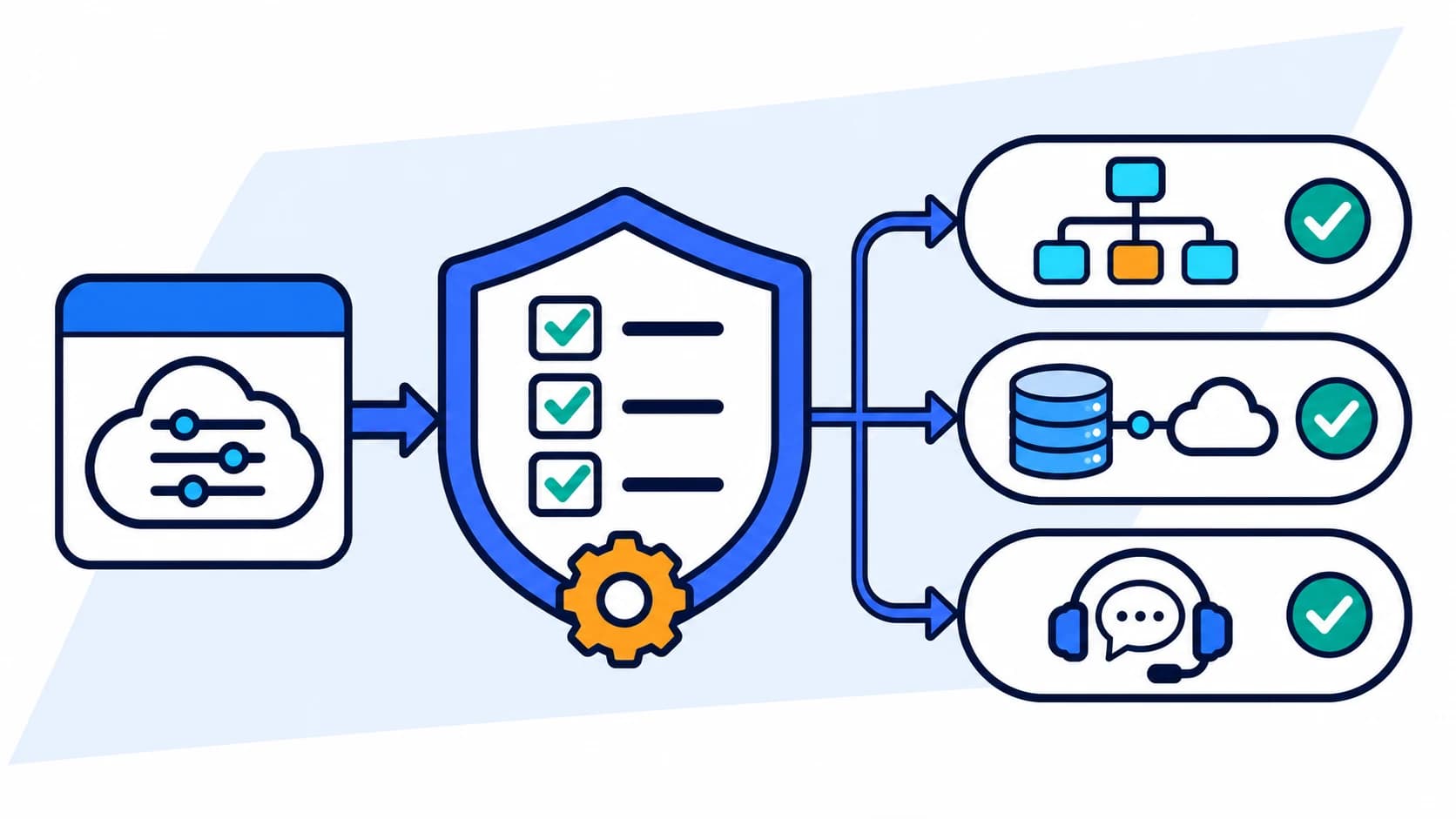
Genesys Cloud Regression Testing: Build a Release Test Pack
Genesys Cloud regression testing is the process of proving that an approved platform change has not broken existing routing, integrations, permissions, schedules, or customer journeys. A useful regression pack connects every test to the changed configuration and its dependencies, runs against controlled inputs, records the expected and actual result, and produces a clear release decision.
That is broader than checking whether an Architect flow validates or whether an API request returns successfully. A release can be technically valid and still send an interaction to the wrong queue, expose the wrong division, use an incorrect schedule, mishandle a backend failure, or leave a digital journey without a working fallback.
This guide shows how to build a repeatable release test pack for Genesys Cloud. It includes a practical matrix, a hypothetical worked example, pipeline gate behavior, evidence requirements, and a clear boundary between configuration validation, customer-journey testing, and production monitoring.
What Is Genesys Cloud Regression Testing?
Genesys Cloud regression testing checks whether previously working behavior still works after a configuration, integration, or release change. The goal is not to retest the entire contact center after every deployment. The goal is to select the journeys and controls that could reasonably be affected, then prove that the release has not introduced an unacceptable regression.
A regression test should answer five questions:
- What changed?
- Which objects, systems, channels, and users depend on it?
- Which existing business outcomes could be affected?
- What evidence proves each outcome still works?
- What result blocks, pauses, or permits the release?
For example, changing an inbound flow may affect prompts, queues, schedules, data actions, skills, wrap-up behavior, and fallback routes. Testing only the edited task misses the behavior created by those dependencies.
The detailed automation of voice menus remains a separate discipline. Use the automated IVR testing guide for call generation, DTMF and speech inputs, prompt recognition, telephony paths, and outside-in voice testing. This article owns the wider release test pack that connects those journey tests with configuration, governance, and deployment evidence.
Start with the Change and Dependency Inventory
The smallest useful regression pack begins with the release scope. List the objects being added, changed, removed, or remapped, then expand the list to the resources that consume or support them.
Genesys Cloud Architect provides a Dependency Search for checked-in and published flows. It can locate references to resources such as queues, prompts, data actions, skills, decision tables, scripts, and wrap-up codes. Its documented limits matter: working flows, unsaved versions, and some dynamically referenced resources may not appear. Treat the search as evidence, not as a guarantee that the dependency list is complete.
Use three inputs to build the inventory:
- The proposed change: the exact objects and fields included in the release.
- Known dependencies: referenced queues, schedules, prompts, integrations, data actions, permissions, scripts, and environment-specific identifiers.
- Operational journeys: the customer or agent outcomes that rely on those objects.
Then prioritize by impact and likelihood.
| Change signal | Regression risk | Tests to consider |
|---|---|---|
| Architect flow logic changed | A previously working branch, fallback, or transfer behaves differently | Happy path, invalid input, no input, failure path, timeout path, transfer result |
| Queue, skill, or routing rule changed | Interactions reach the wrong team or do not route | Queue destination, skill eligibility, priority, overflow, agent delivery |
| Data action or integration changed | Lookup, authentication, or response mapping fails | Success, empty result, invalid result, backend error, timeout, degraded fallback |
| Schedule group changed | Open, closed, holiday, or emergency behavior is wrong | Boundary times, time zone, holiday order, emergency override |
| Role, permission, or division changed | A user gains too much access or loses required access | Allowed action, denied action, division visibility, privileged function |
| Digital flow or message routing changed | A message stalls, routes incorrectly, or loses context | Entry, bot or flow path, escalation, queue delivery, transcript or context handoff |
Do not select tests only because they are easy to automate. A fast test that cannot detect the release's main risk creates activity without useful assurance.
Separate the Three Testing Layers
A mature contact center regression-testing process separates configuration checks, deployed-journey tests, and production verification. Each layer answers a different question.
1. Configuration and release validation
This layer asks whether the proposed configuration is internally valid, reviewable, and suitable for the target environment.
Architect validation can find errors and warnings within a flow before publication. Genesys documents that red validation errors must be resolved, while yellow items are warnings or recommendations. Validation is necessary, but it cannot prove that an external dependency returns the expected business result or that a real interaction reaches the intended destination.
Release validation should also check target mappings, missing dependencies, unsupported changes, approvals, and the available recovery action. A Genesys Cloud CI/CD pipeline can place those checks before execution rather than leaving them to a manual production review.
2. Deployed-journey regression tests
This layer exercises the behavior after the release reaches a controlled environment. It may use API checks, digital test interactions, controlled user accounts, or an outside-in voice-testing tool.
The test must prove the business outcome, not merely the technical response. A data action returning HTTP 200 does not prove that it returned the right customer record. A successful transfer action does not prove that the interaction reached the correct queue with the required context.
3. Production smoke tests and monitoring
This layer confirms that a small set of critical journeys still works after production deployment. Smoke tests should be limited, controlled, and safe to run against live systems. They should not create customer records, trigger real communications, or distort operational reporting unless those side effects have been explicitly designed and approved.
Continuous Genesys Cloud monitoring then watches availability, performance, configuration drift, and important live signals over time. Monitoring can discover a production problem after release. Regression testing decides whether a known change is safe to promote. Neither should be presented as a substitute for the other.
Build a Reusable Regression Test Pack
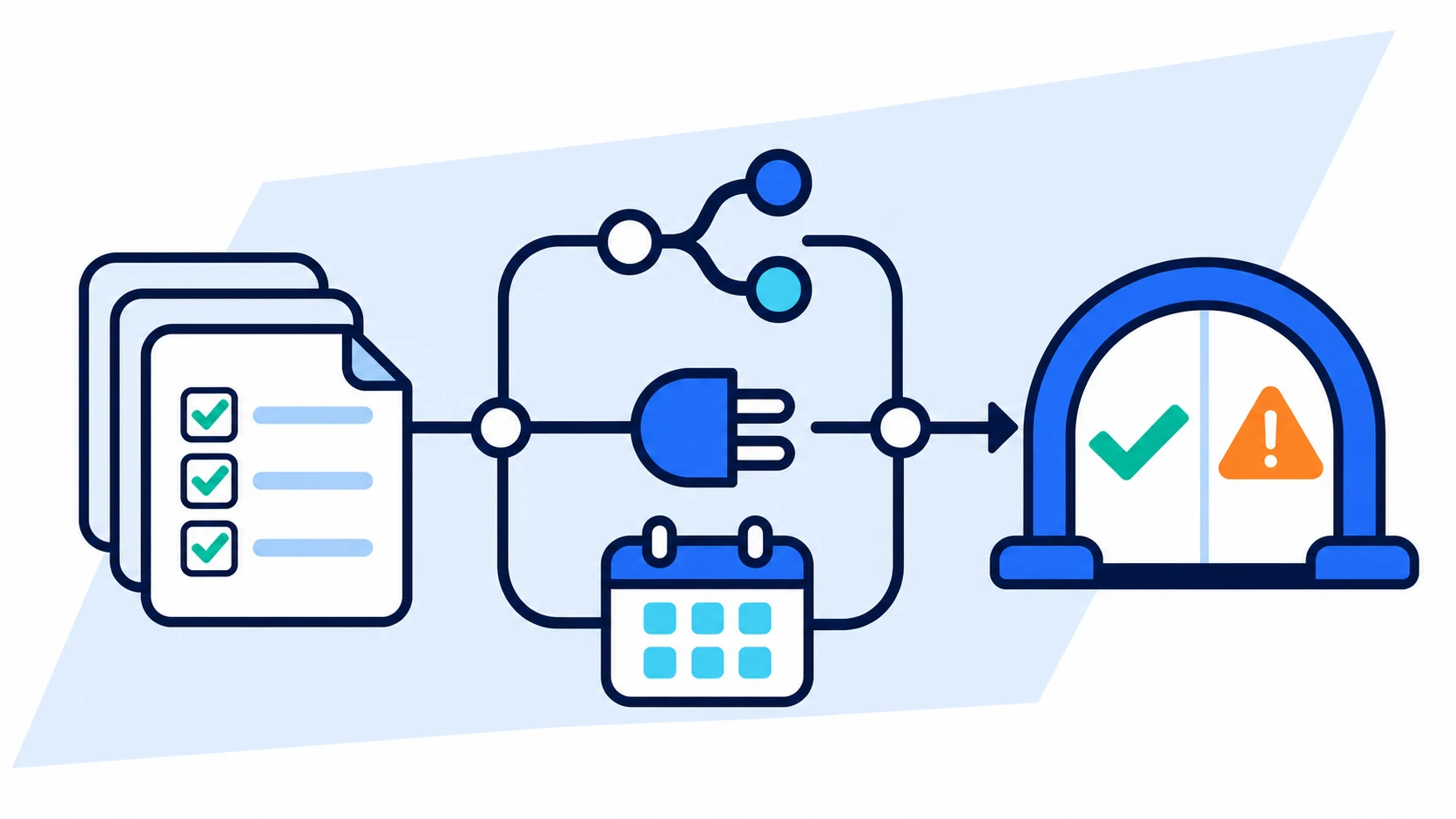
A test pack should be readable by the release owner, the tester, and the approver. At minimum, each case needs:
- A stable test-case ID.
- The changed object or dependency it covers.
- The target environment and channel.
- Controlled input data or a controlled test identity.
- A precise expected result.
- The evidence to retain.
- A named owner.
- The release-gate result when the test fails, times out, or cannot run.
The following example is a template, not a universal test suite. Select and adapt the cases that match the release scope.
| ID | Risk covered | Controlled test | Expected result | Retained evidence | Gate result |
|---|---|---|---|---|---|
| RT-001 | Open-hours routing | Start the approved journey during the open schedule | Interaction reaches the expected test queue with required context | Timestamp, conversation ID, queue and outcome | Fail release if destination or context is wrong |
| RT-002 | Closed and holiday routing | Run at a controlled boundary or evaluate the approved schedule condition | Closed or holiday path is selected in the configured time zone | Schedule version, evaluated condition and destination | Fail release if the wrong branch is selected |
| RT-003 | Invalid or missing input | Supply an invalid value, then no value | Approved retry, fallback, or agent route is used | Inputs, prompts or messages, final destination | Fail release if the journey traps or disconnects unexpectedly |
| RT-004 | Data-action success | Submit a known test record | Correct mapped response is used in the journey | Sanitized request key, response fields, duration and next step | Fail release if returned data or mapping is wrong |
| RT-005 | Data-action failure | Use an approved failure fixture or unavailable test dependency | Flow follows the designed failure path | Error class, failure output and customer-facing result | Fail release if failure handling is unsafe or unclear |
| RT-006 | Data-action timeout | Use an approved delayed test response | Flow exits through the intended timeout or failure behavior | Duration, timeout configuration and final route | Fail release if the interaction waits too long or has no fallback |
| RT-007 | Permission and division boundary | Use one authorized and one unauthorized test user | Required user succeeds; unauthorized user is denied | Test identities, role or division context and observed result | Fail release on excessive access or lost required access |
| RT-008 | Digital escalation | Start a controlled digital journey and request escalation | Context reaches the intended queue or agent route | Conversation ID, routing result and retained context | Fail release if the handoff stalls or loses required context |
The Genesys Cloud Call Data Action documentation distinguishes success, failure, and timeout paths. It also notes that a technically successful action is not proof that the returned data is the intended result. Your test pack should make that distinction explicit.
Schedule behavior needs the same precision. Genesys documents that operating schedule groups evaluate holiday, closed, and open schedules in a defined order, with emergency routing evaluated first when active. Test the actual boundary and time-zone assumptions instead of recording only that a schedule group exists. See the official operating schedule group guidance for the current behavior.
Worked Example: A Hypothetical Billing-Routing Release
The following example is hypothetical. It demonstrates the evidence model and does not describe a customer deployment or measured outcome.
Assume a release changes four connected items:
- An inbound Architect flow adds a billing self-service path.
- A data action returns account status for a controlled test customer.
- A billing queue receives the fallback transfer.
- An operating schedule group controls open and closed behavior.
The release owner maps each change to a risk before selecting tests.
| Test | Controlled input | Expected outcome | Evidence | Decision |
|---|---|---|---|---|
| Valid account during open hours | Known non-production account and open schedule | Correct account status is presented; no fallback transfer occurs | Flow version, sanitized account key, response mapping and conversation result | Pass only when data and journey result agree |
| Unknown account | Approved unknown-account fixture | Customer receives the approved message and reaches the billing test queue | Failure output, prompt or message, queue and conversation ID | Block if journey disconnects or routes elsewhere |
| Slow backend response | Delayed non-production endpoint | Configured timeout behavior runs and the interaction reaches the approved fallback | Start time, elapsed time, timeout result and destination | Block if wait or fallback violates policy |
| Closed schedule | Closed-hours test condition | Closed path runs in the intended time zone | Schedule group, evaluated branch and final outcome | Block if open-hours service is offered incorrectly |
| Unauthorized support user | Test user outside the required division | Restricted configuration or data remains unavailable | User, role and division context, denied operation | Block if unauthorized access succeeds |
This pack does not need every permutation of the flow. It needs enough coverage to prove the release's material risks. If the billing path also includes voice prompts and DTMF entry, attach the relevant outside-in IVR cases rather than copying the full IVR suite into this release document.
Put Regression Testing into the Release Pipeline
Regression testing becomes more reliable when the release process determines when the pack runs, which results are required, and what happens when evidence is missing.
A practical sequence is:
- Package the reviewed configuration change.
- Validate the artifact and target-environment dependencies.
- Deploy to a non-production environment.
- Run the selected regression pack.
- Wait for final results, including asynchronous checks.
- Block, pause, or approve promotion according to policy.
- Deploy to production after approval.
- Run a small production smoke set and retain the complete release record.
The Genesys Cloud API guide explains why a successful API operation is only one checkpoint. The Terraform and CX-as-Code pipeline guide covers the wider promotion process for declarative resources. InProd changesets and validation can govern supported configuration changes, while the selected journey-testing tools provide the behavioral result.
This separation is important. InProd is not a general-purpose telephony or digital interaction generator. Its role is to help make supported configuration changes reviewable, target-aware, controlled, and traceable through the release process.
Define failure, timeout, and inconclusive results
Do not reduce every non-pass result to a generic red status.
- Failed: the observed result differs from the expected result. The release is blocked unless an authorized exception process exists.
- Timed out: the test or dependency exceeded its approved limit. Record whether the flow followed the designed customer-safe path. A timeout with a good fallback still indicates a dependency problem that needs a release decision.
- Inconclusive: the test could not produce trustworthy evidence because of test-data, environment, or tool failure. Do not silently convert this to a pass.
- Not applicable: a documented impact review shows the case is outside this release. Record the reason rather than deleting the case from history.
When an existing Architect flow is updated and published, Genesys states that the new configuration takes effect immediately. That makes pre-production evidence and a production recovery plan especially important. See the official Architect publishing guidance.
Keep the Test Pack Reliable
Regression suites lose value when they become slow, flaky, or detached from current configuration. Treat the pack as a maintained release asset.
Use controlled identities and data
Keep test users, accounts, queues, and destinations separate from real customers wherever possible. Record the permitted side effects and reset process. Mask sensitive values in retained evidence.
Map environment differences explicitly
Object IDs, integration endpoints, credentials, schedules, and data fixtures can differ between Development, UAT, and Production. Store the logical dependency in the test case, then resolve the approved value for the target environment. Copying a production identifier into UAT is not environment validation.
Investigate flaky tests instead of normalizing them
Repeatedly rerunning a failing test until it passes hides useful information. Record the first result, classify the cause, and decide whether the test, environment, or product behavior is unstable. A retry policy should be bounded and visible in the evidence.
Select tests by impact
Tag each case to the objects and journeys it protects. A queue-only change may not require every digital bot test, but it may require every journey that transfers to that queue. Run the smallest pack that still covers the credible impact.
Give every case an owner
The platform team may own configuration validation, while a QA or channel team owns outside-in journey tests and an operations team owns production smoke checks. One release owner should still be accountable for assembling the final evidence and obtaining approval.
Use configuration auditing to retain what changed and who approved it. Pair that record with the test result so an incident reviewer can connect the observed behavior to the exact release.
Regression Testing vs UAT, Monitoring, and Disaster Recovery
These controls overlap, but they do not answer the same question.
| Control | Primary question | Typical timing | Evidence |
|---|---|---|---|
| Configuration validation | Is the proposed artifact valid and suitable for this target? | Before deployment | Validation result, dependency mapping and approval |
| User acceptance testing | Does the proposed behavior meet the agreed business need? | Before initial release or material change | Business scenarios, acceptance criteria and sign-off |
| Regression testing | Did this release break behavior that should still work? | After change in a controlled environment and before promotion | Selected test-pack results linked to the release |
| Production smoke testing | Do the most critical live paths work immediately after deployment? | Directly after production release | Controlled live outcomes and timestamps |
| Monitoring | Is service or behavior degrading over time? | Continuously or on a schedule | Metrics, alerts, journey checks and incident records |
| Disaster-recovery exercise | Can the organization restore priority service after serious disruption? | On a planned rehearsal cycle and after relevant incidents | Recovery actions, elapsed time, restored state and journey validation |
The Genesys Cloud disaster-recovery guide explains how journey validation proves that recovery produced a usable service. Regression testing provides many of the reusable cases for that proof, but a recovery exercise also tests ownership, communications, restoration, and operational readiness.
Genesys Cloud Regression Testing Checklist
Before approving a release, confirm that the team has:
- Recorded every changed object and material field.
- Mapped direct, indirect, dynamic, and environment-specific dependencies.
- Identified the customer, agent, compliance, and operational outcomes at risk.
- Selected happy-path, invalid-input, failure, timeout, permission, schedule, and channel cases where relevant.
- Defined controlled identities, data, destinations, and permitted side effects.
- Written an observable expected result for every case.
- Assigned an owner and a gate outcome for failed, timed-out, and inconclusive tests.
- Linked results to the reviewed release artifact and target environment.
- Confirmed the recovery action before production deployment.
- Run a controlled production smoke set and retained the final evidence.
Frequently Asked Questions
What should a Genesys Cloud regression test pack include?
It should include the release scope, affected dependencies, controlled inputs, expected business outcomes, retained evidence, an owner, and a release decision for every case. Select cases according to the change's credible impact rather than running every available test after every release.
Is Architect validation the same as regression testing?
No. Architect validation finds configuration errors and warnings within the flow. Regression testing proves that deployed behavior still produces the expected routing, integration, permission, schedule, and customer-journey outcomes.
Can Genesys Cloud regression testing be automated?
Yes, where the result can be exercised safely and assessed consistently. API checks, controlled digital interactions, outside-in IVR tools, and pipeline orchestration can automate parts of the pack. Human review may still be required for business acceptance, complex experience quality, exceptions, and final release approval.
How often should regression tests run?
Run the relevant pack for each material release before production promotion. Run a smaller smoke set immediately after production deployment. High-value automated checks may also run on a schedule, but scheduled monitoring should remain distinguishable from release-specific regression evidence.
What is the difference between contact center regression testing and IVR testing?
Contact center regression testing can cover routing, integrations, permissions, schedules, digital channels, agent delivery, and voice journeys across a release. IVR testing is the voice-specific subset that validates telephony entry, prompts, DTMF or speech, transfers, and caller outcomes.
Who should own the release decision?
One release owner should assemble the evidence and apply the organization's approval policy. Platform, QA, channel, security, and operations teams may own individual checks, but fragmented test ownership should not create an unclear final decision.
Turn the Test Pack into a Release Control
A regression pack creates value when it changes the release decision. It should show what changed, what could break, what was tested, what happened, and whether the evidence supports promotion.
InProd helps teams package and validate supported Genesys Cloud configuration changes, promote them through controlled environments, and retain release evidence. Connect that governance with the testing tools that exercise your real customer and agent journeys.
Review your Genesys Cloud release and regression-testing workflow with InProd.

Jarrod Neven
Contact Center Expert, Director at InProd Solutions
Jarrod has been working in the enterprise CX space since 2001. Before starting InProd, he spent several years as a CTI Solutions Architect at Genesys itself, working across the APAC region with enterprise and government customers, which gives him a different perspective on how their platforms actually work under the hood. He's been Director at InProd Solutions since 2016, helping organizations cut through the complexity of Genesys Engage deployments.