
Infrastructure as Code vs. Configuration as Code: What's the Difference?
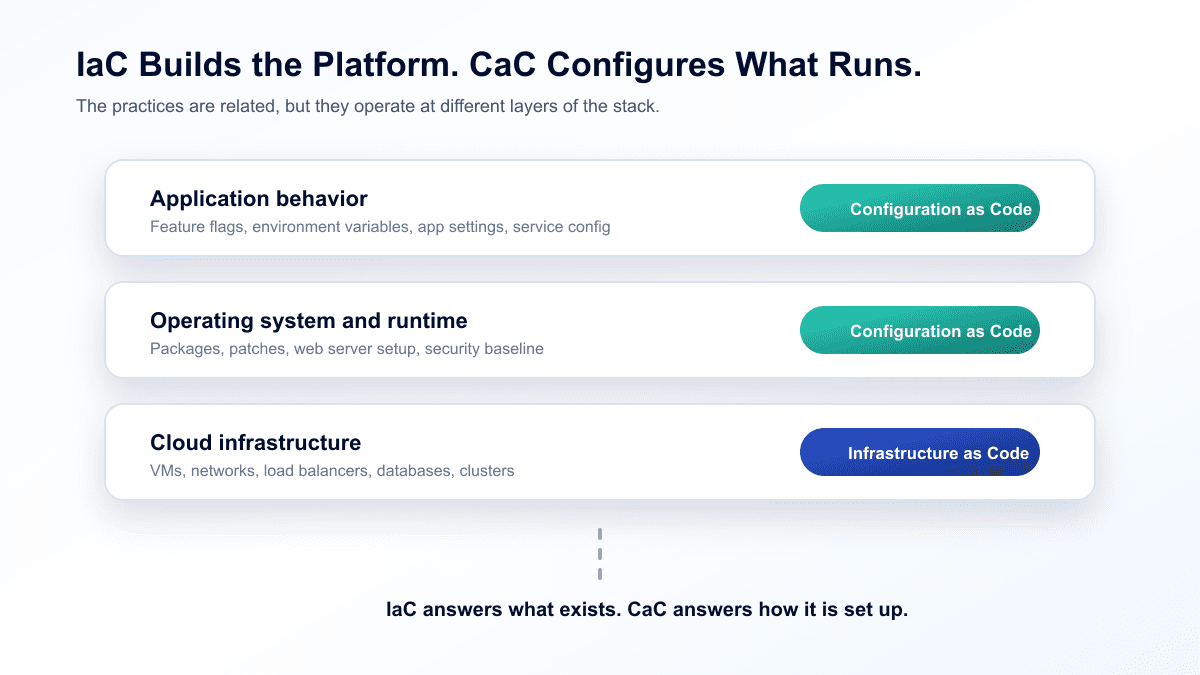
Infrastructure as Code (IaC) provisions and manages infrastructure resources such as networks, compute, databases, and managed cloud services. Configuration as Code (CaC) defines and applies the operating-system, runtime, application, or SaaS settings that make those resources usable. Both practices store desired state in version control, but they usually act on different layers and produce different outcomes.
Configuration management is not automatically Infrastructure as Code. The practices overlap, and some tools can perform both jobs, but configuration management usually controls the state of an existing system while IaC creates or changes the infrastructure itself. That distinction helps teams choose the right tool, pipeline stage, drift control, and rollback plan.
Infrastructure as Code vs Configuration as Code: The Short Answer
Infrastructure as Code (IaC) provisions and manages the underlying resources: servers, networks, databases, load balancers. Configuration as Code (CaC) sets up and manages what runs on top of that infrastructure once it exists: installed packages, application settings, feature flags, environment variables.
Put simply: IaC builds the thing. CaC configures the thing once it's built. In a well-run pipeline, they run sequentially, not interchangeably: IaC provisions an empty virtual machine, and CaC bootstraps it into a working server.
What Infrastructure as Code (IaC) Actually Does
IaC treats physical and virtual infrastructure the same way software engineers treat application code: as something you write, version, test, and deploy through a repeatable process, not something you click together by hand in a cloud console.
What IaC Manages
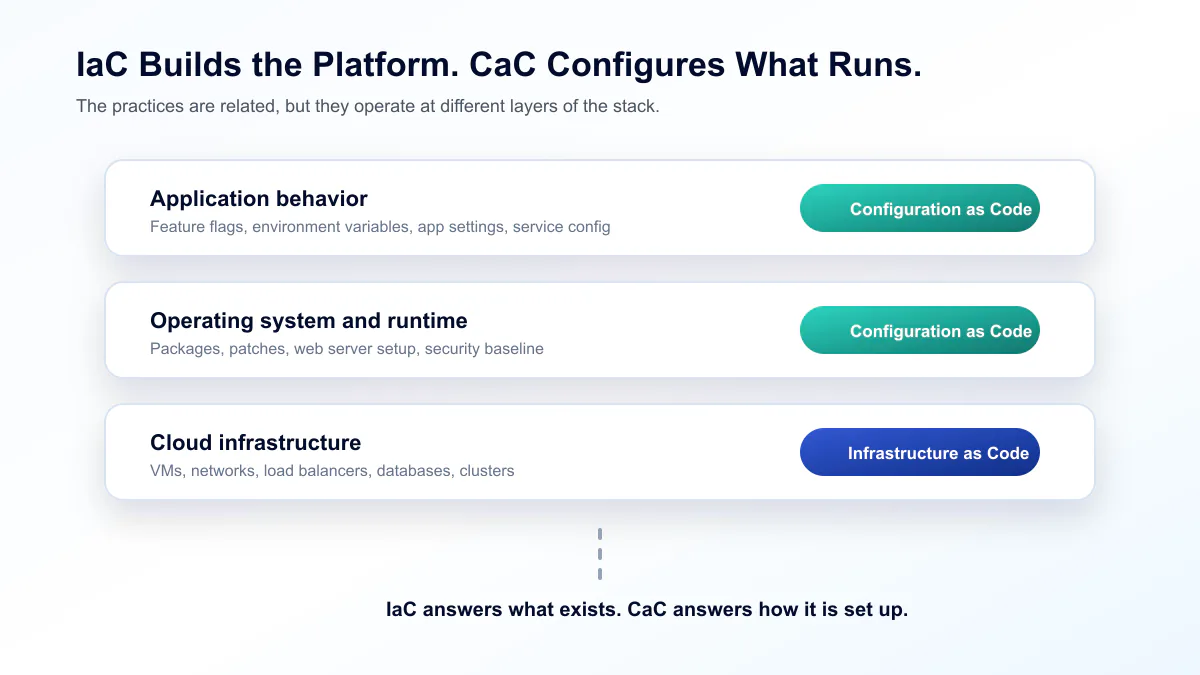
IaC operates at the hardware and virtualization layer. Typical responsibilities include:
- Virtual machines: defining instances with specific CPU, RAM, and storage constraints
- Networking: scripting firewalls, subnets, gateways, and load balancers
- Managed services: spinning up a managed database instance or a Kubernetes cluster
The output of an IaC run is infrastructure that exists: a VM is running, a subnet is created, a cluster is provisioned. But that infrastructure is typically still bare. It doesn't yet have your application installed, your configuration files in place, or your services running.
Popular IaC Tools
Terraform is the most widely used tool in this category, alongside OpenTofu (its open-source fork) and cloud-native options like AWS CloudFormation. These tools generally work in a declarative style: you describe the desired end state of your infrastructure, and the tool figures out how to get there.
What Configuration as Code (CaC) Actually Does
CaC, often used interchangeably with the broader term Configuration Management, picks up where IaC leaves off. It deals with what happens inside a piece of infrastructure once it exists, making sure the software running on it stays consistent, correctly configured, and doesn't drift out of its intended state over time.
What CaC Manages
CaC operates at the operating system and application layer. Typical responsibilities include:
- OS settings: opening internal system ports, adjusting registry or system-level configuration
- Package deployments: ensuring the right runtime versions, web servers, and security patches are installed
- Application properties: managing environment variables, API keys, and feature flag settings across dev, staging, and production
Where IaC answers "does this server exist," CaC answers "is this server actually set up the way it's supposed to be."
Popular CaC Tools
Ansible, Puppet, Chef, and SaltStack are the standard tools here. Most use an agent-based or agentless model to apply and continuously enforce a desired configuration state across a fleet of machines, catching and correcting drift when a system's actual state diverges from what it's supposed to be.
IaC vs. CaC: Side-by-Side Comparison
| Question | Infrastructure as Code (IaC) | Configuration as Code (CaC) |
|---|---|---|
| Primary goal | Create, modify, and destroy infrastructure | Set up and maintain system/application state |
| Layer | Hardware, virtualization, network | Operating system and application |
| Typical input | Declarative resource definitions, modules, variables, and provider configuration | Playbooks, manifests, policies, templates, and application configuration |
| Key actions | Provisioning a VM, creating a VPC subnet | Installing packages, updating config files, managing feature flags |
| Popular tools | Terraform, OpenTofu, AWS CloudFormation | Ansible, Puppet, Chef, SaltStack |
| Result of a run | Infrastructure resources exist in the requested state | Existing systems or applications have the requested configuration |
| Primary drift question | Does deployed infrastructure still match the declared resource state? | Does the running system or application still match its approved configuration? |
When to Use IaC, Configuration as Code, or Both
Use IaC when the change is primarily about creating or modifying infrastructure. Use Configuration as Code when the target already exists and the change is about how that system, application, or SaaS platform behaves. Use both when a deployment needs a complete environment and a repeatable application state.
| Scenario | Best fit | Why |
|---|---|---|
| Create a virtual network, Kubernetes cluster, database, or load balancer | IaC | The pipeline is provisioning infrastructure resources |
| Install packages and enforce OS settings on existing servers | Configuration as Code | The infrastructure exists; the required state is inside it |
| Build a new environment and configure the application running in it | IaC followed by CaC | Provisioning and configuration are separate, dependent stages |
| Manage queues, routing, permissions, schedules, or integrations in a SaaS platform | Configuration as Code | The vendor operates the infrastructure while the customer governs platform configuration |
| Apply supported Genesys Cloud resources through Terraform | CX as Code with governed deployment controls | Terraform drives the API, but the operational concern is controlled contact-center configuration across organizations |
The tool name alone does not decide the category. Terraform is commonly associated with IaC, but a provider can also manage application or SaaS resources. Ansible is commonly associated with configuration management, but modules can provision cloud resources. Classify the work by the resource being controlled and the outcome of the run, then design the pipeline and evidence around that boundary.
How IaC and CaC Work Together in a Deployment Pipeline
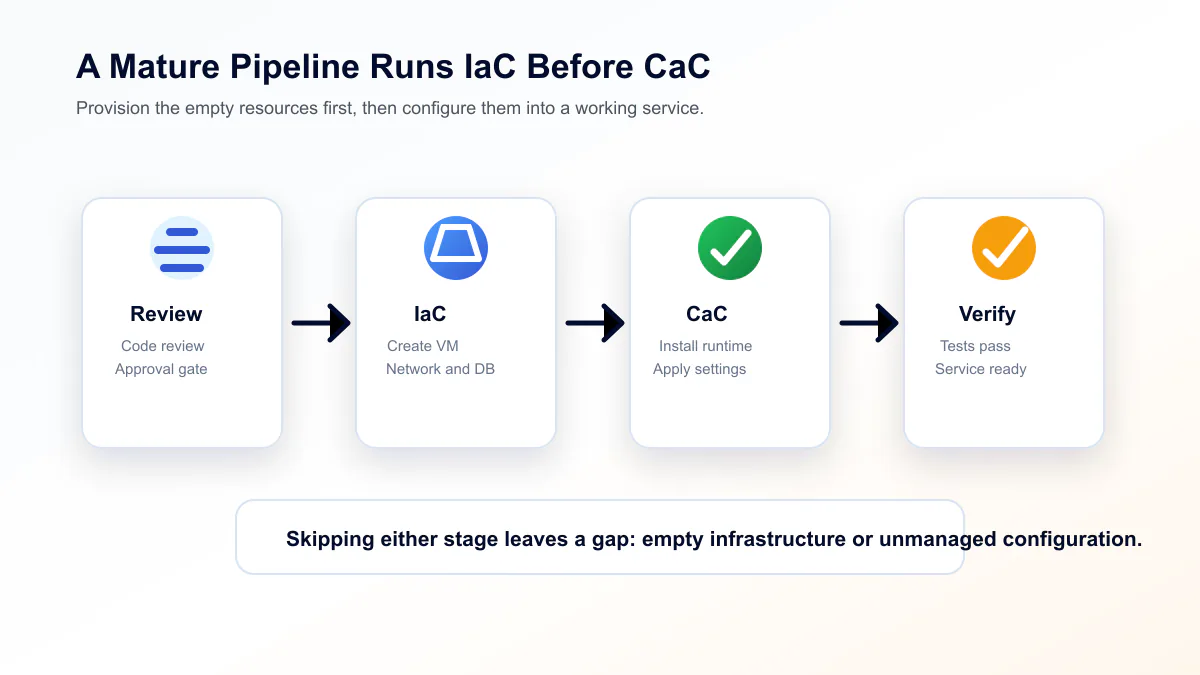
In practice, these aren't competing approaches; they're sequential stages of the same pipeline. A typical flow looks like:
- IaC runs first, provisioning the raw infrastructure: an empty virtual machine, a network, a managed database shell.
- CaC runs immediately after, bootstrapping that infrastructure into something usable: installing dependencies, applying configuration, and starting the application.
Skipping either step leaves a gap. IaC alone gets you infrastructure with nothing running on it. CaC alone has nothing to configure until the infrastructure exists. Mature DevOps pipelines treat both as essential, connected phases rather than alternative choices.
Common Points of Confusion
Is IaC Part of CI/CD?
Yes, typically as one of the earlier stages. IaC provisioning usually runs as part of a CI/CD pipeline's deployment phase, often gated behind approval steps for production environments, since infrastructure changes can have wide-reaching effects.
Are IaC and Terraform the Same Thing?
No. Terraform is one implementation of the IaC pattern, not the pattern itself. IaC is the practice; Terraform, OpenTofu, and CloudFormation are tools that implement it, each with different syntax and cloud-provider relationships.
Is Configuration Management Infrastructure as Code?
Not usually. Infrastructure as Code provisions or changes infrastructure resources. Configuration management defines, applies, and verifies the state of systems that already exist. Configuration as Code is the version-controlled implementation of that configuration-management work.
The boundary is not absolute. Ansible can provision cloud resources, and Terraform providers can manage SaaS configuration. In those cases, classify the task by what the code controls: creating a network or cluster is IaC; applying application settings, contact-center routing, or permissions is configuration management expressed as code. A mature pipeline can use both without pretending they are the same practice.
Beyond Servers: Applying CaC Principles to SaaS Platform Configuration
Most discussions of IaC and CaC assume a traditional infrastructure stack: VMs, containers, cloud networking. But the underlying idea behind Configuration as Code, treating configuration as versioned, testable, auditable code rather than manual changes, applies just as well to platforms that don't hand you servers at all.
Modern SaaS platforms, particularly complex ones like CCaaS (Contact Center as a Service) platforms, have deep, consequential configuration layers of their own: routing rules, integrations, permission structures, workflow logic. There's no VM to provision because the infrastructure is already managed by the vendor, but the configuration on top of it behaves exactly like the problem CaC was built to solve: it drifts, it changes without a clear record, and a bad change is hard to trace back to its source.
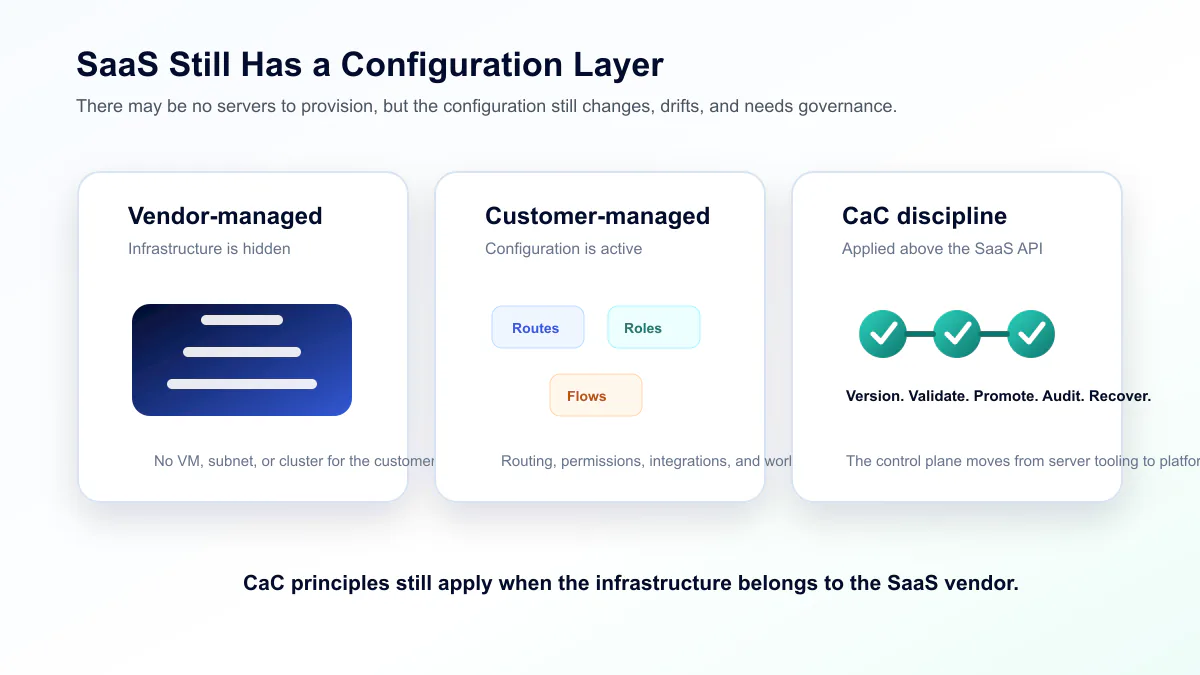
This is the space InProd operates in specifically for Genesys Cloud and Genesys Engage contact centers: applying CaC-style discipline through version-controlled Genesys configuration, environment promotion, drift detection, and configuration audit trails. The vendor operates the underlying infrastructure, while the contact-center team governs the platform configuration that determines routing, access, integrations, and customer experience.
Genesys Cloud teams can use the Genesys Cloud Terraform provider and CX as Code for supported resources. The remaining operational question is how those changes are validated against each target organization, promoted, audited, and recovered when code-managed and Admin UI changes coexist.
FAQ
What is the difference between IaaS and IaC?
IaaS (Infrastructure as a Service) is a cloud computing model: a vendor like AWS or Azure providing virtualized infrastructure over the internet. IaC (Infrastructure as Code) is a practice for provisioning and managing that infrastructure through code rather than manual configuration. IaC is often used to provision resources within an IaaS platform, but the two terms describe different things: one is a delivery model, the other is a management practice.
Is IaC considered DevOps?
Yes. IaC is one of the foundational practices of DevOps, applying software development principles (version control, automated testing, code review) to infrastructure management. It supports the broader DevOps goals of faster, more reliable, more repeatable deployments.
How does IaC fit into a CI/CD pipeline?
Generally yes. IaC provisioning commonly runs as an automated stage within a CI/CD pipeline, particularly for spinning up or updating environments as part of a deployment process.
Book a call to see how InProd brings CaC-style version control, environment promotion, and audit trails to Genesys Cloud configuration.

Jarrod Neven
Contact Center Expert, Director at InProd Solutions
Jarrod has been working in the enterprise CX space since 2001. Before starting InProd, he spent several years as a CTI Solutions Architect at Genesys itself, working across the APAC region with enterprise and government customers, which gives him a different perspective on how their platforms actually work under the hood. He's been Director at InProd Solutions since 2016, helping organizations cut through the complexity of Genesys Engage deployments.