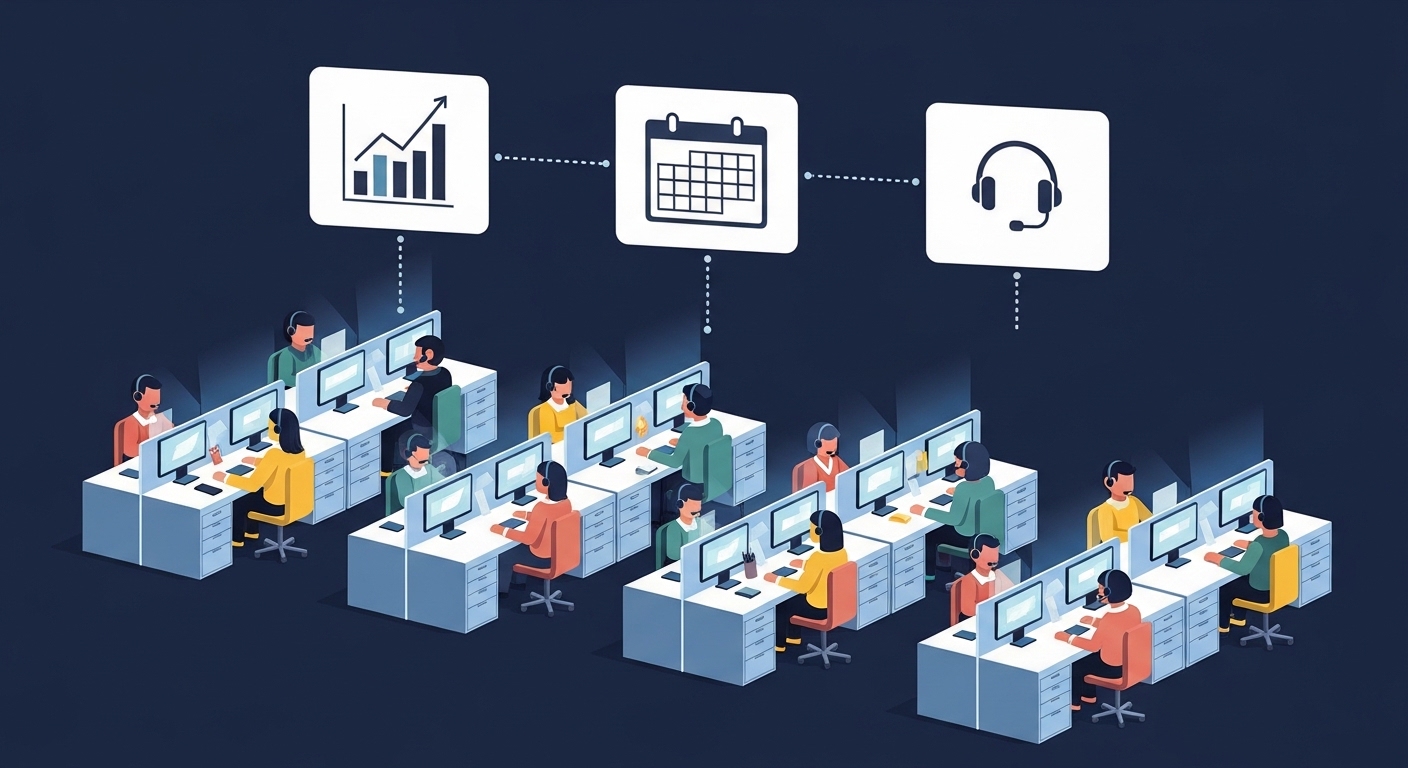
Contact Center Planning: A Complete Guide to Workforce, Capacity & Operational Strategy
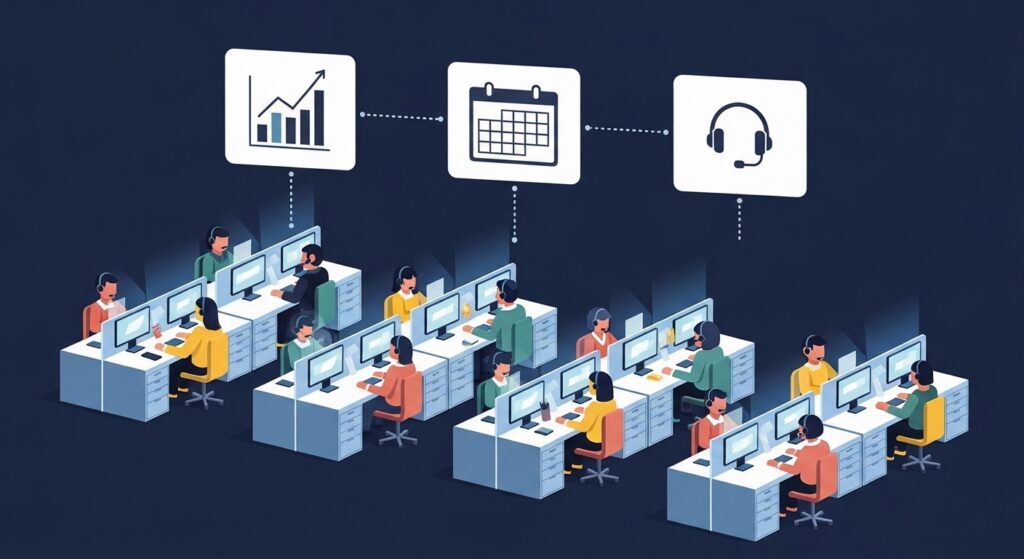
Contact center planning is the strategic and operational process of ensuring your contact center has the right people, processes, and systems in place to meet customer demand — consistently, efficiently, and without disruption. It covers everything from forecasting inbound call and chat volumes to aligning staffing levels, managing schedules, and maintaining the underlying systems that keep operations running.
Done well, contact center planning reduces cost, protects service level agreements (SLAs), and creates a better experience for both customers and agents. Done poorly, it creates staffing gaps, missed SLAs, costly downtime, and cascading operational failures that are difficult to recover from quickly.
Effective planning spans multiple dimensions: demand forecasting, capacity planning, workforce management (WFM), shrinkage accounting, and operational governance. This guide covers each of these areas in depth — including the often-overlooked risks that sit between your planning models and your live production environment.
What Is Contact Center Planning?
Contact center planning is the ongoing process of aligning an organization’s staffing resources, scheduling frameworks, and technology systems with the volume and complexity of customer interactions across all channels — voice, chat, email, and digital.
It is not a one-time exercise. Effective contact center planning operates as a continuous cycle, moving through phases of forecasting, headcount modeling, scheduling, real-time monitoring, and post-period analysis. Planning happens at multiple time horizons simultaneously: long-range annual planning, monthly capacity reviews, weekly scheduling, and intraday adjustments.
Workforce planning focuses on ensuring the right number of agents are hired, trained, and scheduled. Capacity planning focuses on whether that workforce is sized correctly relative to projected contact volumes and service level targets. Operational planning ensures the systems, configurations, and change processes that support the workforce are stable, reliable, and governed.
Together, these three layers form the foundation of high-performing contact center operations.
The Core Components of Contact Center Planning
Demand Forecasting
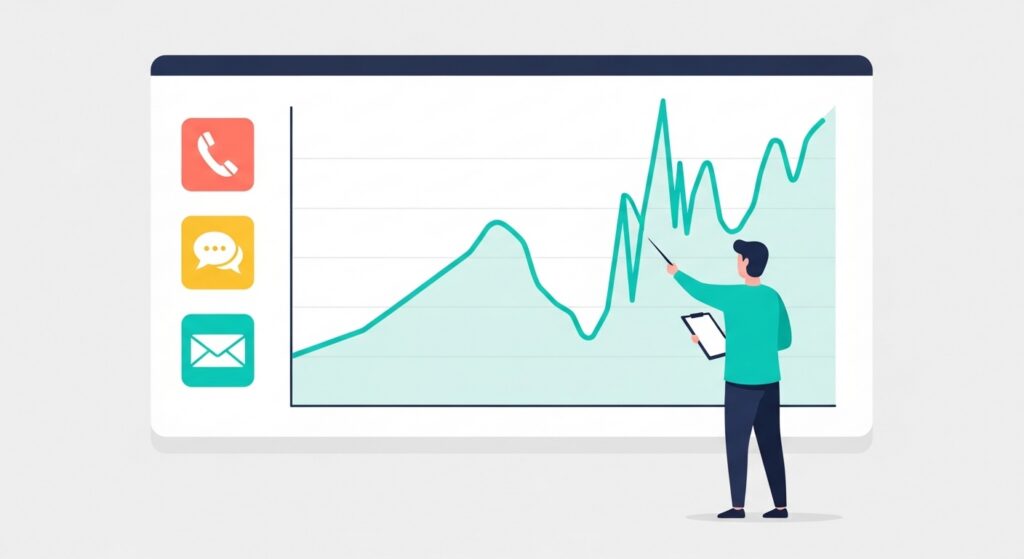
Demand forecasting is the foundation of every other planning decision. Without an accurate view of expected contact volume, no staffing model — however sophisticated — will produce reliable results.
Effective forecasting draws on historical contact data to identify patterns: time-of-day peaks, day-of-week variation, seasonal spikes, and long-term growth trends. It also accounts for channel mix shifts as customers increasingly move between voice, chat, and digital self-service. Average Handling Time (AHT) — the combined duration of talk time, hold time, and after-call work — is a critical variable because even small changes in AHT have significant downstream effects on staffing requirements.
Most contact centers forecast in 15- to 30-minute intervals to capture intraday demand patterns accurately. Forecast accuracy is typically measured using Mean Absolute Percentage Error (MAPE). A forecast that is consistently off by 10–15% can result in hundreds of misallocated agent hours per week and chronic SLA underperformance — even when the underlying workforce model is correct.
Capacity & Staffing Planning
Once contact volume forecasts are in place, capacity planning translates those forecasts into headcount requirements. The goal is to determine how many agents are needed — at any given interval — to meet a defined service level target, such as the widely used 80/20 standard: answering 80% of contacts within 20 seconds.
The Erlang C model is the most common mathematical framework for this calculation. It accounts for contact arrival rates, AHT, and desired service levels to generate raw staffing requirements. These requirements are then adjusted upward to account for shrinkage — the portion of agent time consumed by training, meetings, breaks, and unplanned absence.
Longer-term capacity planning extends this model to headcount projections over months and quarters, incorporating growth forecasts, attrition assumptions, and hiring lead times. Without this layer, contact centers frequently find themselves understaffed during growth periods — not because the workforce plan was wrong, but because hiring and onboarding cycles were not factored in early enough.
Workforce Management & Scheduling
Workforce management (WFM) bridges the gap between capacity planning and daily operations. It translates staffing requirements into workable agent schedules, accounting for skill-based routing, shift preferences, labor agreements, and coverage targets across multiple queues and channels.
Long-term WFM strategy determines shift patterns, full-time versus part-time ratios, and multi-skilling investments. Short-term scheduling (weekly and daily) fine-tunes agent assignments against the most current forecasts. Intraday management monitors real-time adherence and reforecasts throughout the day — adjusting for unexpected volume spikes, agent no-shows, or system-driven performance changes.
Schedule adherence is a core WFM metric, measuring how closely agents follow their assigned schedules. Low adherence — even when sufficient agents are rostered — directly degrades service levels and increases the likelihood of SLA breaches during peak intervals.
Shrinkage & Contingency Planning
Shrinkage refers to any paid agent time that is not available for handling customer contacts. It includes planned shrinkage — training, team meetings, breaks, coaching sessions — and unplanned shrinkage, such as absenteeism, late arrivals, and system outages.
Industry average shrinkage typically ranges from 25–35%, though it varies significantly by operation type, channel mix, and management practice. Staffing models that fail to account for shrinkage consistently produce understaffed schedules, because the raw Erlang output assumes all rostered agents are available and productive throughout their shift.
Contingency planning extends beyond shrinkage to include broader disruptions: severe weather events, technology outages, and unexpected volume surges. Robust contact center planning incorporates contingency protocols — cross-trained agent pools, overflow routing, remote work escalation paths — that can be activated quickly when normal operations are disrupted.
The Contact Center Planning Cycle: A Step-by-Step Framework
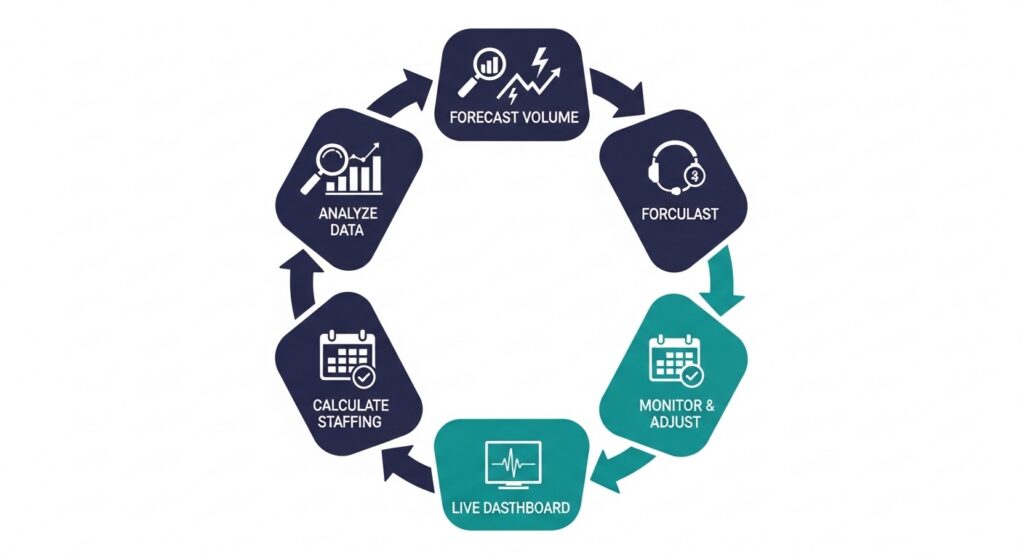
Contact center planning is not a linear process — it is a continuous cycle that repeats across multiple time horizons. The following framework reflects how high-performing operations structure their planning cadence:
1. Analyze Historical Data — Review contact volume by channel, time period, and queue. Examine AHT trends, abandonment rates, and service level outcomes. Identify seasonal patterns and anomalies that will inform the forecast baseline.
2. Forecast Contact Volume — Build short-term (weekly/daily) and long-term (monthly/quarterly) forecasts using statistical models applied to historical data. Develop scenario plans for high-volume events, product launches, or known seasonal peaks.
3. Calculate Staffing Requirements — Apply Erlang C or equivalent modeling to translate forecasts into per-interval headcount requirements. Apply shrinkage rates to produce gross staffing targets. Compare against available headcount to identify gaps.
4. Build & Optimize Schedules — Assign agents to shifts aligned with coverage requirements. Prioritize skill matching to ensure the right agent types are available during peak demand windows. Use WFM software to automate schedule generation and optimization.
5. Monitor & Adjust in Real Time — Track live service levels, queue statistics, and agent adherence throughout the operating day. Reforecast as needed and make intraday adjustments — redistributing agents, opening overflow queues, or activating contingency resources — to protect SLA performance.
6. Review & Refine — After each planning period, conduct a post-period review comparing forecasts to actuals. Identify systematic forecast biases, adherence issues, or capacity gaps. Feed findings back into the next planning cycle.
Where Contact Center Planning Often Fails
Most organizations invest heavily in forecasting tools and WFM platforms — and still experience costly service disruptions. The reason is that the most common planning failures are not forecasting failures. They are operational and governance failures that occur between the planning model and the live production environment.
Poorly Planned Changes & Misconfigurations
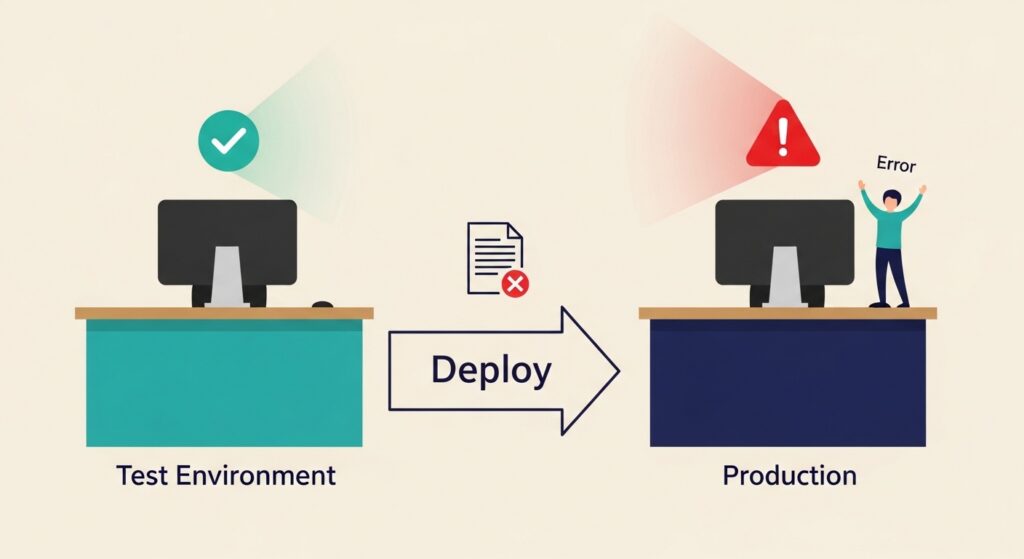
Contact centers run on complex, interconnected technology platforms — routing engines, IVR systems, skill-based routing configurations, workforce management integrations, and CRM connections. In environments like Genesys, configuration changes are a routine part of operations: updating routing logic, modifying agent skills, adjusting queue priorities, deploying new IVR flows.
The problem is that these changes are often managed manually — and humans make costly mistakes in many forms. It could be an engineer making a typo when manually replicating changes from a test environment into production. It could be a handover issue, where the engineer who developed the change is not the same person performing the deployment. Either way, the result is the same: an unplanned outage that could have been avoided.
The data on this is unambiguous. The IT Process Institute’s Visible Ops Handbook reports that 80% of unplanned outages are due to ill-planned changes made by administrators or developers. Digging deeper into root causes, the Enterprise Management Association found that 60% of availability and performance errors are the direct result of misconfigurations — the small, incremental changes made to environment and system configuration parameters on a day-to-day basis. A Gartner study reinforced this, projecting that 80% of outages impacting mission-critical services are caused by people and process issues, with more than half of those outages specifically attributable to change, configuration, release, and handoff failures.
The financial consequences are equally stark. Manual configuration errors can cost companies up to $72,000 per hour in downtime — and application maintenance costs are increasing at 20% annually. In a separate survey, 35% of respondents reported that at least one quarter of their downtime was caused by configuration errors alone.
This is the planning gap that most organizations fail to close: strong demand forecasts and optimized schedules can be instantly undermined by a single misconfigured routing rule deployed without proper governance.
The Hidden Cost of Poor Planning
The costs of inadequate contact center planning extend well beyond the immediate operational disruption. SLA breaches trigger financial penalties in outsourced and B2B environments, damage client relationships, and — in regulated industries — invite compliance scrutiny. For consumer-facing operations, sustained service failures generate customer churn, negative reviews, and social media exposure that takes months to reverse.
At the agent level, poor planning creates chronic occupancy spikes that drive burnout and attrition. High attrition forces ongoing recruitment and training cycles that consume budget and reduce the effective experience level of the workforce. It is a compounding cost spiral that starts with a planning failure and rarely resolves itself without deliberate intervention.
Operational resilience — the ability to absorb disruptions and recover quickly — is therefore not a luxury feature of mature contact centers. It is a core planning requirement, and one that must be deliberately designed, not assumed.
The Role of Technology in Modern Contact Center Planning
Technology supports contact center planning at every stage of the planning cycle, from demand forecasting and schedule optimization to real-time monitoring and post-period analysis.
Workforce Management (WFM) software — platforms such as NICE IEX, Verint, and Calabrio — automates forecasting, scheduling, and intraday management, reducing manual planning effort and improving consistency across planning intervals. Contact center platforms like Genesys Cloud provide the routing, IVR, and skills-based distribution infrastructure that WFM schedules are built around. Analytics and reporting tools provide the real-time and historical visibility required for intraday management and post-period review.
But in complex environments — particularly those running Genesys Cloud at enterprise scale — configuration governance becomes a critical and often underinvested planning layer. The fastest way to improve stability within a Genesys Cloud platform is to remove manual deployment processes from the production environment entirely. Doing so ensures that changes are consistently and correctly applied, and prevents poorly planned or incorrectly executed configurations from reaching production in the first place.
This is where tools like InProd are designed to help. InProd provides automated change control management, auditing, and rollback capabilities for Genesys Cloud environments — enabling DevOps teams to automate their change control processes without slowing down existing change management strategies. The result is faster deployment, reduced human error, a complete audit trail of every change across environments, and the ability to reverse a problematic deployment quickly when something goes wrong. For contact centers where a single misconfiguration can trigger a five- or six-figure downtime event, the ROI is direct and measurable.
The Future of Contact Center Planning
Contact center planning is evolving rapidly, driven by advances in artificial intelligence, automation, and cross-functional integration.
AI-powered forecasting is replacing traditional statistical models, producing more accurate predictions across longer time horizons and more granular intervals — incorporating non-traditional signals like marketing campaign schedules and external demand indicators. Predictive analytics platforms can now identify agents at risk of attrition or adherence failure before those patterns become operational problems, enabling proactive intervention. Automation-driven scheduling reduces the manual effort required to build and adjust schedules, improving both planning efficiency and agent experience.
At the infrastructure level, leading contact centers are beginning to apply DevOps-style governance to configuration management — treating routing logic and platform configuration as code, with version control, automated testing, and governed deployment pipelines. This approach fundamentally changes the risk profile of operational changes, turning what has historically been a source of unplanned outages into a controlled, auditable, and reversible process.
The most forward-looking operations are also breaking down the silos between WFM, IT, and CX operations teams — creating unified planning processes where workforce strategy and system governance are managed as a single, integrated function. The contact centers that will perform best in the years ahead are those that plan not just for staffing, but for operational resilience across every layer of the system.
Frequently Asked Questions
What is contact center planning? Contact center planning is the process of aligning staffing, scheduling, and technology systems with expected customer contact volumes to meet service level goals. It encompasses demand forecasting, capacity planning, workforce management, shrinkage accounting, and operational governance — operating as a continuous cycle rather than a one-time exercise.
What is the difference between workforce planning and capacity planning? Workforce planning focuses on the people dimension — recruiting, training, and scheduling agents to meet demand. Capacity planning focuses on whether the total workforce is sized correctly relative to projected contact volumes and service level targets. The two are closely related but distinct: you can have strong workforce planning practices and still be capacity-constrained if headcount projections lag growth.
How do you calculate staffing requirements in a contact center? Staffing requirements are typically calculated using the Erlang C model, which takes contact arrival rate, average handling time (AHT), and target service level as inputs and produces a required number of agents per interval. The output is then adjusted upward to account for shrinkage — the proportion of agent time consumed by non-productive activities such as training, meetings, and breaks.
What is shrinkage in workforce management? Shrinkage is the percentage of rostered agent time that is unavailable for handling customer contacts. It includes planned shrinkage (training, meetings, breaks) and unplanned shrinkage (absenteeism, late arrivals, system issues). Industry shrinkage typically ranges from 25–35%. Staffing models that ignore shrinkage produce systematically understaffed schedules.
What tools are used for contact center planning? Core planning tools include WFM platforms (such as NICE IEX, Verint, and Calabrio), contact center platforms (such as Genesys Cloud or Genesys Engage), analytics and reporting tools, and — in complex Genesys environments — configuration governance platforms like InProd that automate change control, auditing, and rollback across Genesys Cloud production deployments.
Why do contact center outages happen? Most contact center outages are not technology failures — they are people and process failures. Research from the IT Process Institute and Gartner consistently finds that the majority of unplanned outages are caused by poorly governed changes to infrastructure and configuration. In contact centers running complex platforms like Genesys, manual configuration changes applied without validation or rollback capability represent a significant and frequently underestimated operational risk.
Contact Center Planning: Summary Overview
| Component | Purpose | Key Metrics | Risk Factors |
|---|---|---|---|
| Demand Forecasting | Predict contact volume across channels | AHT, volume trends, forecast accuracy | Inaccurate data, channel shifts |
| Capacity Planning | Calculate required agent headcount | Service level %, Erlang model output | Understaffing, headcount gaps |
| WFM & Scheduling | Align skills and shifts to demand | Schedule adherence, occupancy rate | Shift misalignment, routing gaps |
| Shrinkage Planning | Account for non-productive agent time | Shrinkage %, buffer headcount | Absenteeism, unplanned leave |
| Change Governance | Control system and config changes | Change failure rate, MTTR | Misconfigurations, deployment errors |
