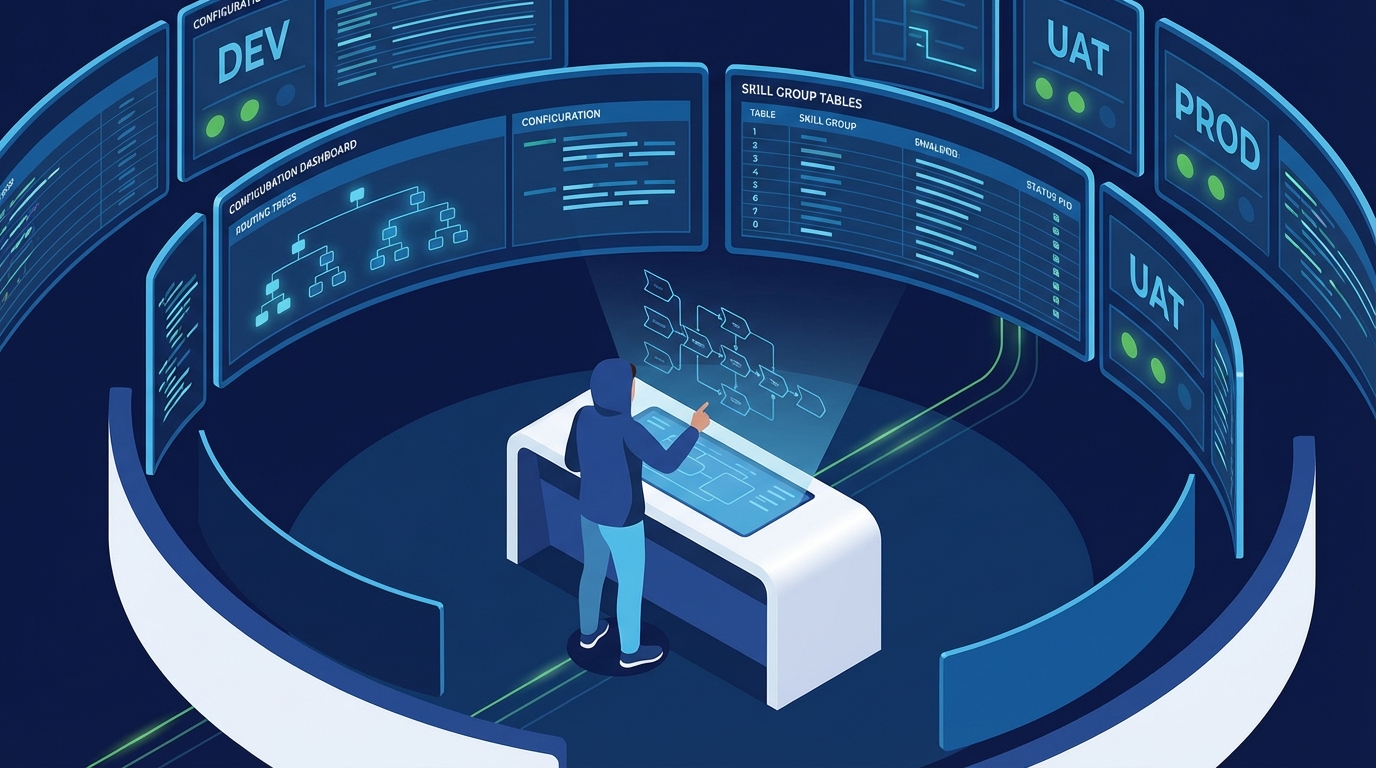
Genesys Configuration Management: One Changeset to Rule Them All
Genesys Configuration Management
Anyone who has been involved with maintaining a Genesys Engage on-premise environment knows that Genesys configuration management can quickly become complex. As contact center systems grow, managing configuration changes across development, testing, and production environments becomes increasingly difficult.
Many organizations struggle with slow change management processes, inconsistent environments, and limited visibility into configuration updates. Unfortunately, most enterprise software vendors do not focus on simplifying the configuration lifecycle. Instead, the typical answer is simply to “move to the cloud.”
But the real question is not cloud versus on-premise. The real challenge is:
How can organizations manage Genesys configuration more efficiently across multiple environments?
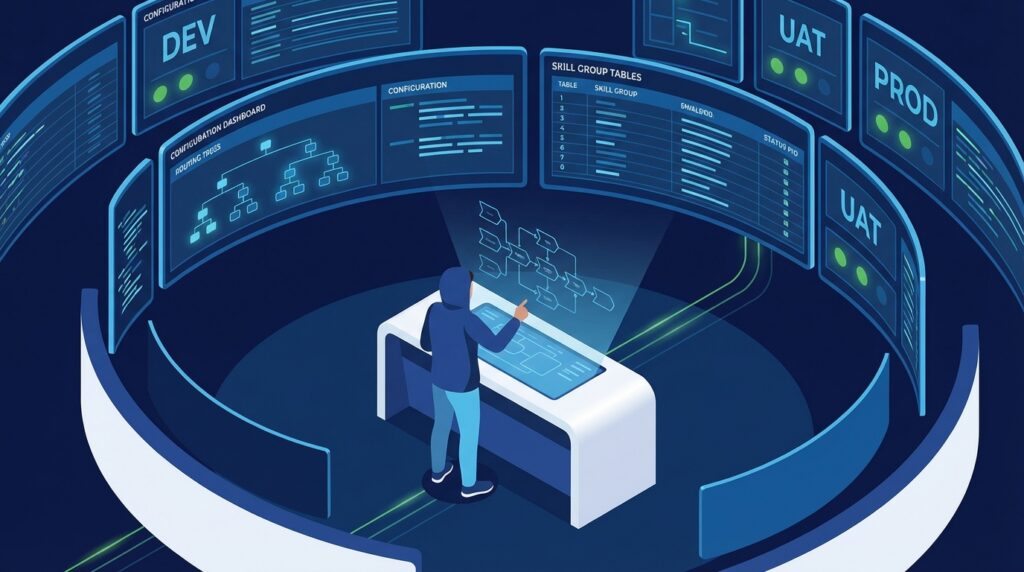
The Challenge of Managing Genesys Configurations Across Environments
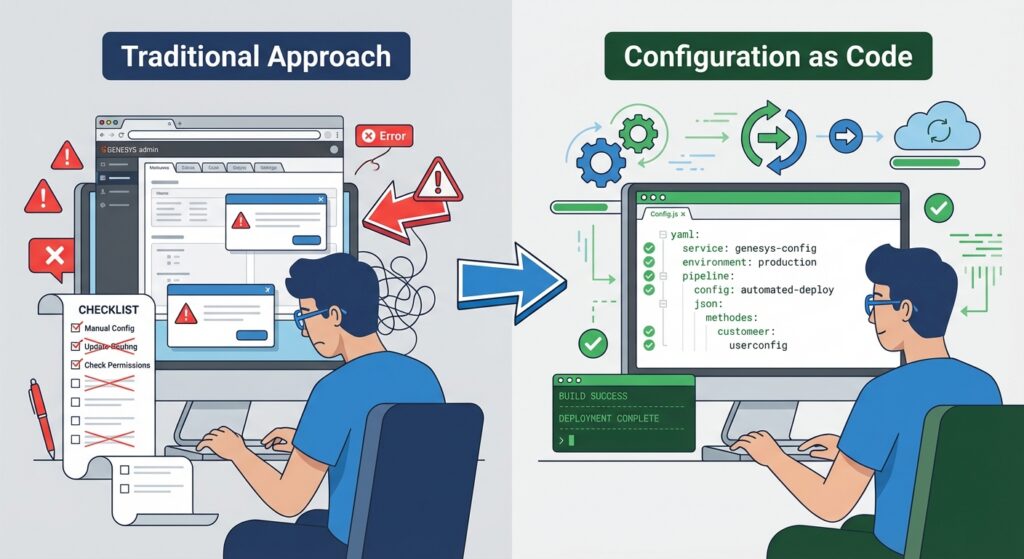
Traditional configuration workflows in Genesys Engage environments often rely on manual updates performed through administrative tools and configuration servers. While functional, this approach introduces several operational challenges that grow more painful as contact center complexity scales.
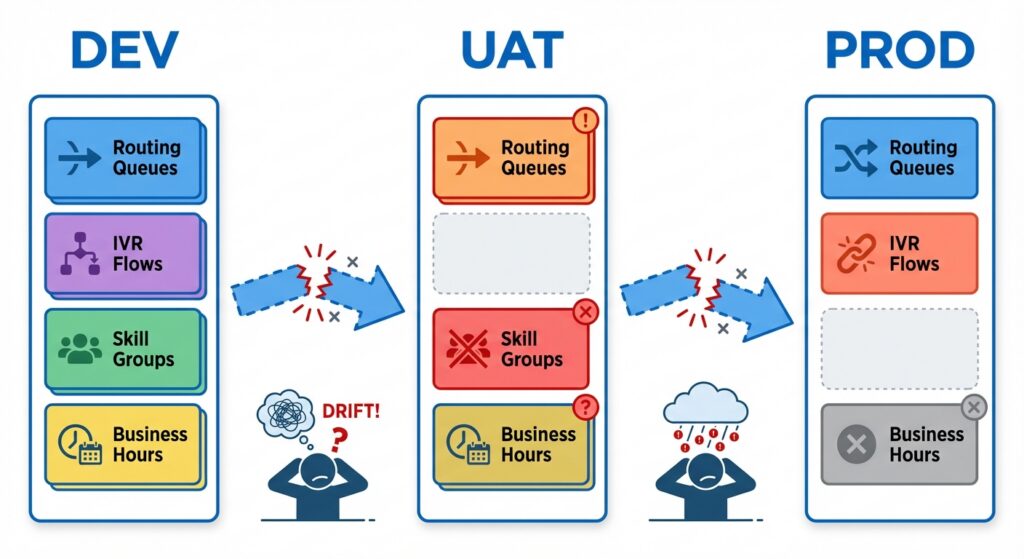
When a change is made in development, an engineer must manually replicate those exact steps in UAT — and then again in production. With dozens or hundreds of interdependent objects such as routing strategies, agent skills, business hours, and IVR flows, the margin for human error is significant.
The most common pain points organizations face include:
- Configuration drift between environments: DEV, UAT, and PROD gradually diverge from one another due to untraceable manual edits made outside any formal process.
- Difficulty replicating changes consistently: especially across large teams managing a shared Genesys environment where no single person has full visibility.
- Slow deployment cycles: manual, step-by-step change procedures bottleneck on the availability of skilled configuration engineers.
- Limited auditing and rollback capability: leaving teams unable to answer “who changed this, when, and why?” after an incident occurs.
As systems grow more complex, maintaining configuration consistency becomes less of an operational inconvenience and more of a business risk. In modern infrastructure environments, however, these problems are typically solved using automation and configuration-as-code practices.
Bringing DevOps Principles to Genesys Configuration
In DevOps environments, tools such as Ansible allow engineers to define infrastructure using configuration files or playbooks. These playbooks describe the desired system state and can be executed repeatedly across multiple environments — removing the human from the repetitive steps that cause inconsistency.
The workflow looks familiar to anyone in modern software engineering:
- An engineer creates a playbook to deploy a new component.
- The same playbook is executed across development, staging, and production.
- If a bug fix or update is required, the playbook is modified and re-run.
This approach — Infrastructure as Code — makes deployments repeatable, automated, and consistent. Changes are stored in version control, reviewed like software, and audited automatically. Rollback is not a manual fire drill; it is a single command.
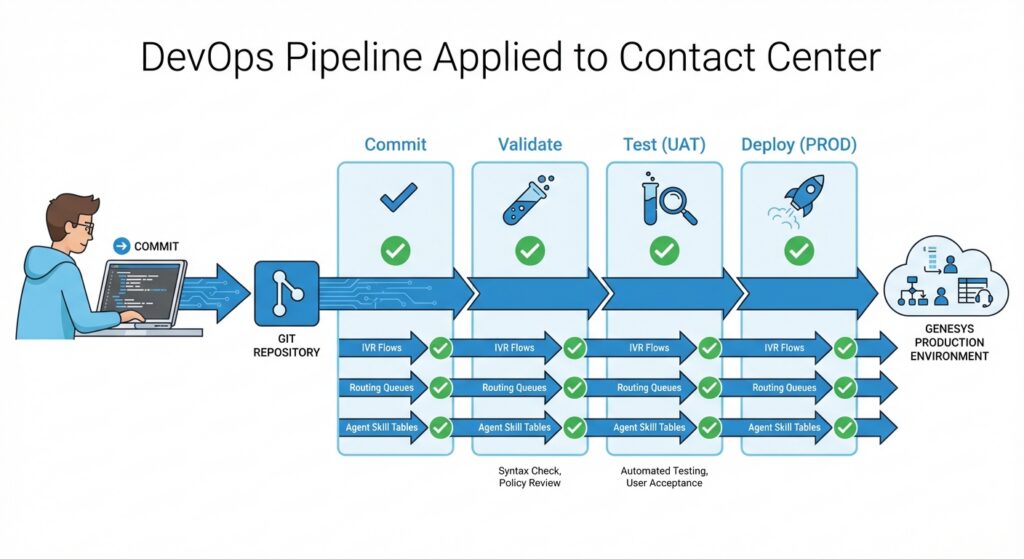
The same concept can be applied to Genesys configuration management. Rather than treating contact center configuration as a series of manual UI actions, it can be treated as code — version-controlled, peer-reviewed, and deployed automatically.
The Rise of Genesys Configuration as Code
Imagine managing your contact center environment the same way modern infrastructure is managed — through version-controlled configuration definitions that are human-readable, repeatable, and environment-agnostic.
Instead of manually repeating configuration changes across systems, teams could:
- Store configuration definitions in version control — giving every change a timestamp, an author, and a reason.
- Deploy configuration updates automatically — eliminating the manual reproduction of changes across environments.
- Maintain consistency across environments — ensuring DEV, UAT, and PROD always reflect the same intentional state.
- Track configuration history and roll back changes — restoring a previous state without needing to remember exactly what was changed.
This concept — Genesys configuration as code — represents a significant shift in how contact center infrastructure is operated. It moves the work upstream: instead of spending hours manually replicating changes and firefighting drift, teams invest that time once to define the change properly, and then deploy it everywhere automatically.
It also fundamentally changes the conversation around risk. When every change is defined, validated, and deployed through a structured process, the question changes from “what broke and who touched it?” to “which changeset introduced this, and how do we revert it?”
Deploying Genesys Changes Across Environments with a Single Changeset
This is where InProd introduces a powerful approach to simplifying configuration deployments.
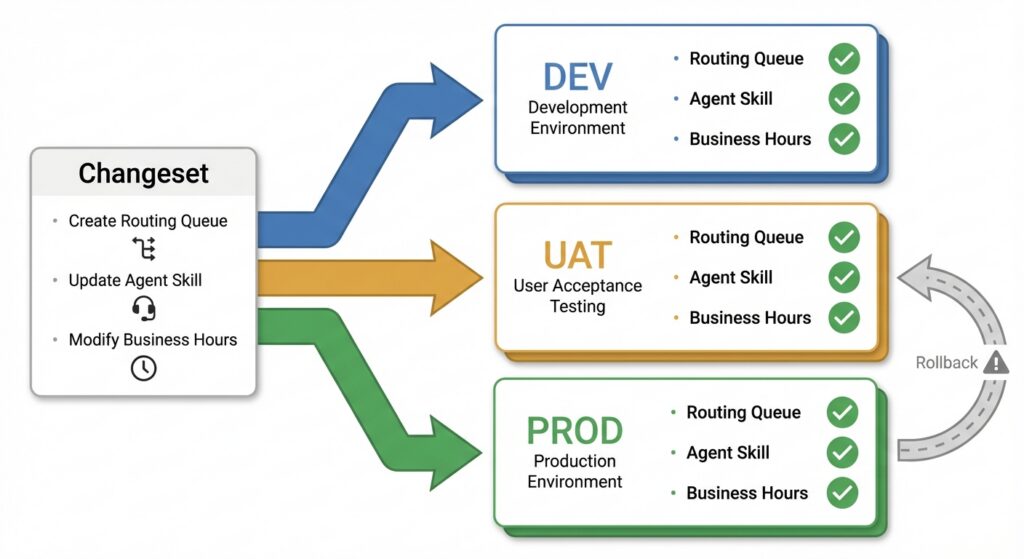
With InProd Changesets, configuration updates are packaged into reusable deployment units that can be applied across multiple Genesys PureEngage environments. A Changeset defines the exact actions to be taken — create, update, or delete specific configuration objects — and stores them as a portable, executable package.
Instead of manually recreating configuration updates in each environment, an engineer creates one Changeset that defines the desired configuration state. That same Changeset is then executed across development, testing, and production environments in sequence.
Key capabilities of InProd Changesets include:
- Simulate Run — validate a Changeset against a target environment before executing, so you can confirm what will change without making any changes.
- Declarative mode — specify the desired end-state rather than individual steps; InProd determines what needs to change to reach that state.
- Iterator and Evaluator scripts — attach JavaScript logic to actions, enabling dynamic behavior such as applying changes to all objects matching a query.
- Reference properties — link configuration objects to one another within a Changeset using object selection, live queries, or references to earlier actions in the same Changeset.
- Git export and CI/CD integration — Changesets can be exported and executed from a pipeline, making Genesys deployments part of an automated release process.
- Auto-generated rollback plans — InProd documents what was changed so that reverting is a structured, repeatable process rather than an improvised scramble.
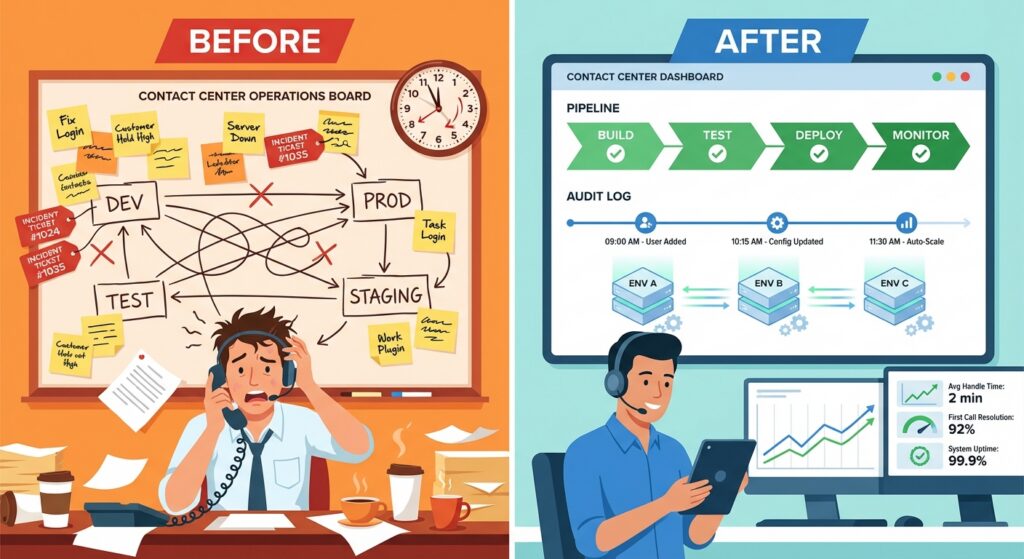
The result is a far more efficient Genesys configuration management workflow. Teams deploy updates faster, maintain consistent environments, reduce operational risk, and gain full visibility into what changed, when, and by whom.
Modernizing Contact Center Configuration Workflows
Managing contact center infrastructure requires three things above all else: reliability, repeatability, and control. A single misconfigured routing strategy can misdirect thousands of calls. A missed rollback window can mean hours of degraded service. A configuration change with no audit trail can make post-incident review nearly impossible.
By adopting a configuration-as-code approach — whether through InProd for Genesys Engage or Genesys’s native CX as Code for Genesys Cloud — organizations can modernize their contact center operations and reduce the complexity associated with large Genesys deployments.
The benefits are not theoretical. Teams that move to structured configuration management typically see:
- Shorter deployment windows — changes that once required hours of manual coordination run in minutes via automated pipelines.
- Fewer production incidents — Simulate Run and environment parity mean fewer surprises when changes hit production.
- Faster incident recovery — when something goes wrong, a clear audit history and automated rollback drastically reduce mean time to recovery.
- Better cross-team collaboration — configuration changes become reviewable artifacts, just like code pull requests, enabling ops and engineering teams to work together more effectively.
The contact center is one of the most operationally critical systems in any customer-facing organization. Treating its configuration with the same discipline applied to application code is not a luxury — it is a necessity for organizations that need to move quickly without breaking things.
See How InProd Simplifies Genesys Configuration Management
If your organization is managing complex Genesys Engage environments and looking for a more efficient way to handle configuration changes, InProd can help.
InProd Changesets streamline the entire Genesys configuration lifecycle — from defining changes and validating them in lower environments, to deploying them reliably into production and maintaining a full audit trail along the way. Whether your team is running a single Genesys environment or managing configurations across a multi-region, multi-environment enterprise deployment, the principles are the same: define once, deploy everywhere, recover instantly.
Speak with one of InProd’s consultants to see how your Genesys operations can benefit from a more modern configuration management approach.
